A ‘squared circle’ is when a circle and square have equal area, or equal perimeter.
Does the Golden Ratio (phi) define the squaring of a circle. According to some, in ancient Egypt, this mystery was encoded in the mathematics of Giza.
It is well known that the value of pi (3.14) is encoded in the great Khufu pyramid, but when we run the numbers, we find a value for pi that is different to the value on your calculator. Most people think ‘obviously’ that the Egyptians where wrong, with many modern mathematicians claiming it is impossible to square the circle.
What is most interesting about the value encoded at Giza, is that it based on the Golden Ratio, which is the most beautiful number in all the mathematical universe.
Lets explore. If we use what we learnt from the mathematics of the Giza plateau, we get this ‘self referencing’ equation for pi.
sss
“The squaring of the circle is one of the many archetypal motifs which form the basic patterns of our dreams and fantasies. But it is distinguished by the fact that it is one of the most important of them from the functional point of view. Indeed, it could even be called the archetype of wholeness.” Carl Jung
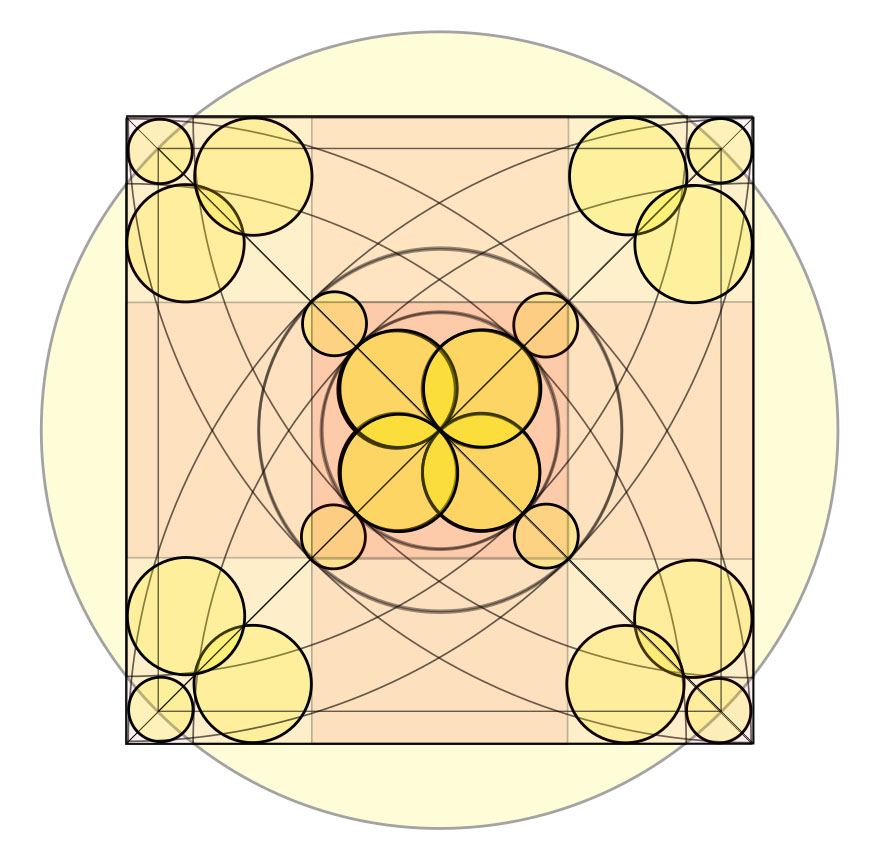
Seems to be a squared circle encoded at Stonehenge.
The Khafre/Chephren or middle pyramid is the key to understanding the geometry and mathematics of the Giza plateau, pointing to the cosmic identity/equation.
The Khafre Pyramid was built according to a 3,4,5 triangle, considered very important by the Egyptians.
The ratios
Scaling the ratios by a half, we can see the the hidden mathematics.
The Cosmic Identity
Khafre points to this cosmic identity, and the relationship to Pythagoras formula.
For each number (x) we have a corresponding right angled triangle.
The link to Pythagoras formula. For Khafre x=2.
We can use this as a key to further understand the geometry of the other pyramids.
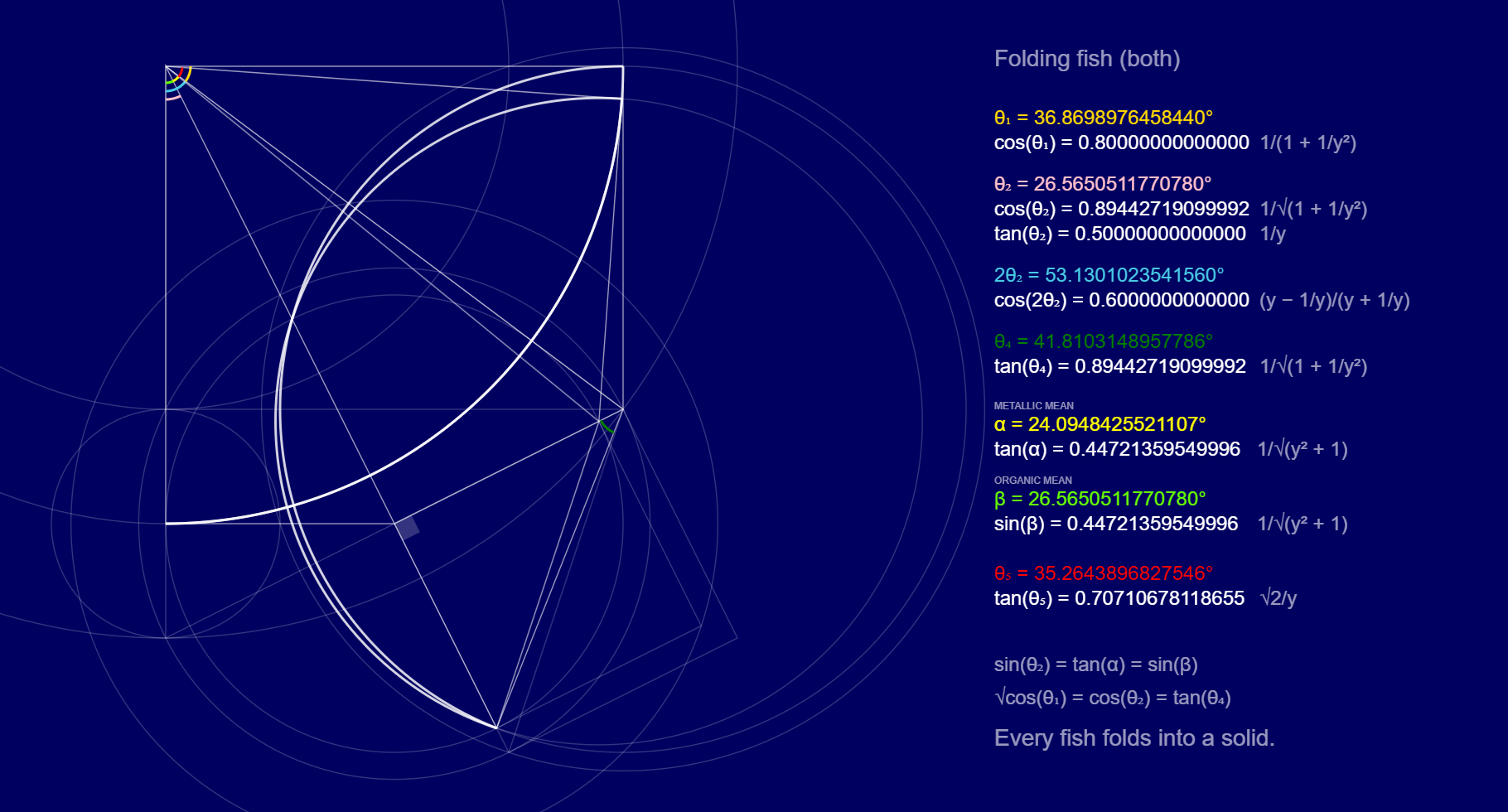
These folding fish fold into a solid 1/8th volume of pyramid.
The geometry of the Kings chamber encodes the 345 triangle and phi.
The two different kinds of folding fish together. Let there be more light.
The geometry of the queens chamber encodes a star of david.
The 8 sides of the Great Pyramid at Giza (3D Khufu)
The pyramids at Giza are sacred gifts of divine knowledge encoded into stone.
Exploring the amazing mystery of the Giza plateau and the three pyramids, the mathematics and geometry encoded into of the pyramids.
Each square fish will fold into 1/8th of a square based pyramid, as shown below with the trusty 345 pyramid (Khafre).
The great pyramid seems to have 8 faces, visible on a solstice?
Giza
UPDATE. The geometry and mathematics of the Kings chamber.
The golden ratio (phi) is encoded into the Kings chamber. As shown above, also encoded is the 3,4,5 triangle, the 2, 3, √5 triangle and versions of the 1, 2, √5 triangle.
The queens chamber and the niche encodes the flower of life and star of David.
More geometry of the Great Pyramid, I seem to have made good progress.
Advanced Dimensions and Mathematics of the Great Pyramid.
ARCHIVE. The location of the Sphinx is related to the golden ratio (phi), as seen below.
The Egyptians used the golden ratio (phi) everywhere.
“Geometry has two great treasures: one is the Theorem of Pythagoras; the other, the division of a line into extreme and mean ratio (phi). The first we may compare to a measure of gold; the second we may name a precious jewel.” Johannes Kepler
The Causeway
The causeway of Khafre and also the causeway of Khufu are the same angle and are represented by the red triangle.
Using what we learnt from Khafre to visualize the geometry of the causeway angle.
The Mathematics of the Giza Plateau
The three Great Pyramids Khufu/Cheops, Khafre/Chephren and Menkaure/Mykerinos, each seem to contain lots of mathematics.
As we will see, Khufu and Menkaure are in essence the ‘same’ pyramid just at a different scale; meaning that they both have the same angles. Khafre (the middle pyramid) is the key to understanding the mathematics of the other two pyramids.
The Three Pyramids of Giza
The mathematics of the 3 main pyramids at Giza. (3 wise men?)
When trying to find actual measurements, we find many varied numbers, so it is impossible to be 100% accurate. (numbers in feet)
Menkaure (226, 178, 288).
Khafre (472, 354, 590).
Khufu (480, 378, 611).
Again, assuming the height of the Khafre relates to the number (2), we can divide the numbers by half the height of Khafre (472/2 = 236), to get the following ratios.
Menkaure (226/236, 178/236, 288/236).
Khafre (472/236, 354/236, 590/236).
Khufu (480/236, 378/236, 611/236).
Interestingly the number 236 could be based on the square root of five (√5 − 2), just like the golden ratio (phi) which is found all over the Giza plateau.
If we compare the numbers, we notice a very interesting relationship between the three pyramids of Giza.
Menkaure (SUB)
226/236 = 0.958 compared to A₁ = 0.971 (99% accurate)
178/236 = 0.754 compared to B₁ = 0.763 (99% accurate)
288/236 = 1.220 compared to C₁ = 1.236 (99% accurate)
Khafre
472/236 = 2 compared to A₂ = 2 (100% accurate)
354/236 = 1.5 compared to B₂ = 1.5 (100% accurate)
590/236 = 2.5 compared to C₂ = 2.5 (100% accurate)
Khufu (SUPER)
480/236 = 2.033 compared to A₃ = 2.058 (99% accurate)
378/236 = 1.601 compared to B₃ = 1.618 (99% accurate)
611/236 = 2.589 compared to C₃ = 2.618 (99% accurate)
Here we can more clearly see the mathematical relationship between the three pyramids and the ‘cosmic’ equation.
The Hidden Pyramid
The amazing relationship between the three main pyramids at Giza.
The Menkaure pyramid (A₁, B₁, C₁).
The Khafre pyramid (A₂, B₂, C₂).
The Khufu pyramid (A₃, B₃, C₃).
The ‘hidden’ pyramid (A₄, B₄, C₄).
In the numbers, we find a ‘hidden’ pyramid with the same height as Khafre and the same angles (essence) as both Menkaure and Khufu.
“Simplicity is the ultimate sophistication.” Leonardo da Vinci
For the Egyptians, it seems the ‘cosmic’ equation was most important. Probably the source of what is now called Pythagoras formula.
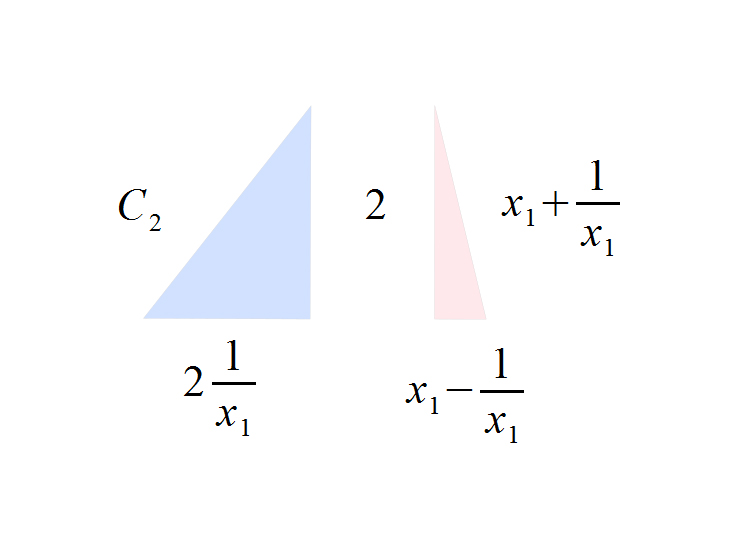
Two circles (1/x) and (x) interact to become two sides of a right angled triangle, with hypotenuse (x+1/x) and base (x−1/x) and with height always equal to the number (2).
Each pyramid at Giza relates to a different version of this magical equation.
This is very interesting because it gives us a different way to
They knew that the reciprocal of zero (0) was infinity ().
The Capstone
The capstone of Khufu, represents the whole of the pyramid pointing at the fractal nature of the numbers.
As above (macro, large), so below (micro, small).
The Kings Chamber
The Kings chamber contains two triangles, the 3-4-5 triangle and the 2-3-√5 triangle.
The 3-4-5 triangle is the same as the ratios of the Khafre pyramid.
Sir Flinders Petrie reported that the floor of the Kings chamber was inset from the walls, and thus the walls can exhibit two heights; one to the floor surface (17 feet) and one to the true base of the wall (19.007 feet).
The inset in the Kings chamber seems to be based on the square root of five (√5 − 2).
Possibly pointing to metallic mean (number 4).
Five and its Square Root
As we have seen, the numbers 3, 4 and 5 represent the middle pyramid and point to the ‘cosmic’ identity.
The number 5 or more precisely the square root of five (√5) is found all over the Giza plateau, lets try and find out why. As we can see below, we find the root of five in both the 1st and the 4th of the metallic means or ‘cosmic’ numbers.
(√5)/2 ± 1/2 = 1.618 (x) and 0.618 (1/x) where x−1/x = 1.
√2 ± 1 = 2.414 (x) and 0.414 (1/x) where x−1/x = 2.
(√13)/2 ± 3/2 = 3.303(x) and 0.303 (1/x) where x−1/x = 3.
√5 ± 2 = 4.236 (x) and 0.236 (1/x) where x−1/x = 4.
The nature of the square (four equal sides). Interestingly we can cut a square into both four equal triangles or squares.
Also, we can cut a square into both five equal triangles or squares.
The fractal nature of the pentagon (five equal sides).
One of the most interesting mathematical identities.
cosmic equation
This ‘cosmic‘ identity works for all numbers (x) in the mathematical universe. And what is interesting is that we can link it to Pythagoras’s theorem. This means that for each number (x) we have a corresponding right angled triangle.
For example, if we make our number (x) equal Phi (Φ).
It is assumed in this article that (x) is always ≥ 1 and the (1/x) is always ≤ 1. And because of the ‘cosmic‘ nature of the numbers, we can write them down like this:
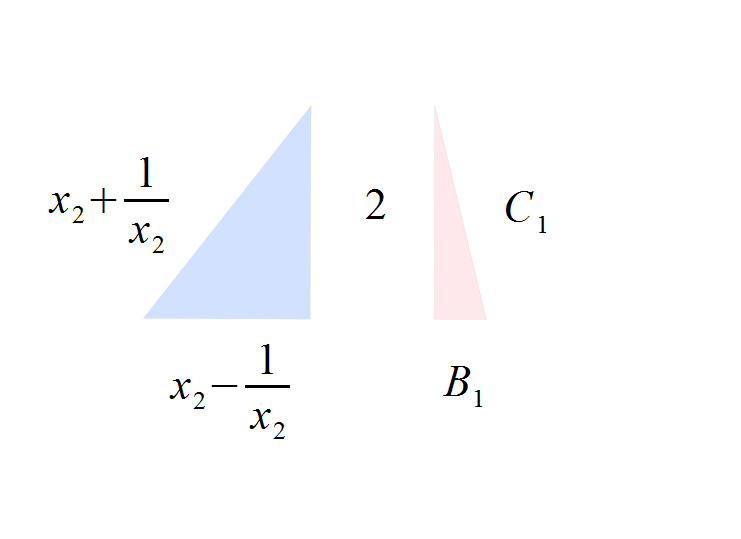
For every triangle, height (A) = 2, base (B) = x-1/x and hypotenuse (C) = x+1/x. This is shown in our example below, where x=Φ, 1/x = 1/Φ and, where A = 2, B = 1 and C = √5 (Square root of 5):
Cosmic Numbers
The following ‘cosmic’ numbers are interesting, because the number (x) minus its reciprocal (1/x) equals the numbers 1-9.
The following ‘cosmic’ numbers are interesting, because the square of the number (x) minus the square of its reciprocal (1/x) equals the numbers 1-9.
Metallic Means
Each cosmic number has a corresponding sequence of numbers, as you can see the first and second sequences are called Fibonacci and the Pell sequence. These sequences are known as the metallic means or silver means.
As you can see below, as these sequences approach infinity, the ratio of the last two consecutive numbers tends towards the number (x).
As you can see below, as these sequences approach zero, the ratio of the last two consecutive numbers tends towards the number (1/x).
These next set of circles and squares all have there areas (a) and circumferences (c) marked, along with the diameter of the circles and the height of the squares. (Fig. 13-15)
The side-length of square
#1 is equal to the diameter of circle #2. The same is true for square
#2 and circle #3 and square #3 and circle #4.
Also, circle #1 and square
#1 have the same area. As do circle #2 and square #2, circle #3 and
square #3 and circle #4 and square #4.
Also, circle #1 and square #2 have the same circumference. As do circle #2 and square #3 and circle #3 and square #4.
Next we stack all the circles and squares on top of each other.
The point marked by the triangles below is the point where the circumference of the circle and the circumference of the square are equal. (Fig. 16)
The point marked by the triangles below is the point where the area of the circle and the area of the square are equal. (Fig. 17)
Unifying the mathematics of the Cosmic Identity with Pythagoras and Trigonometry.
The Cosmic Identity
Cosmic Identity
Pythagoras
We can link this equation with Pythagoras’s theorem.
Cosmic identity and Pythagoras
So that for each number (x) we have a corresponding right angled triangle and each triangle has height (A) = 2, base (B) = x-1/x and hypotenuse (C) = x+1/x.
Double Triangle Formation
The following double triangle formation is found all over the geometric universe.
double triangle formation
Originally I found it in the Vesica Piscis (a type of lens, a mathematical shape formed by the intersection of two disks).
Vesica Piscis
And triangle formation in geometry.
Triangle formation in geometry.
Trigonometry
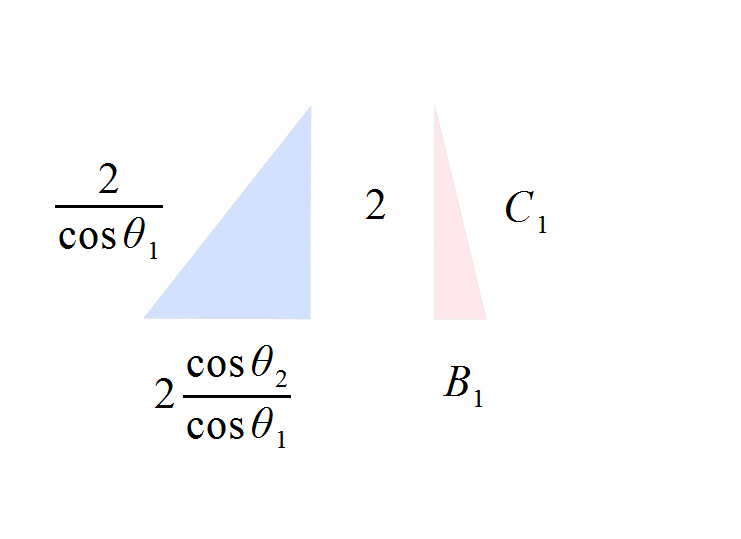
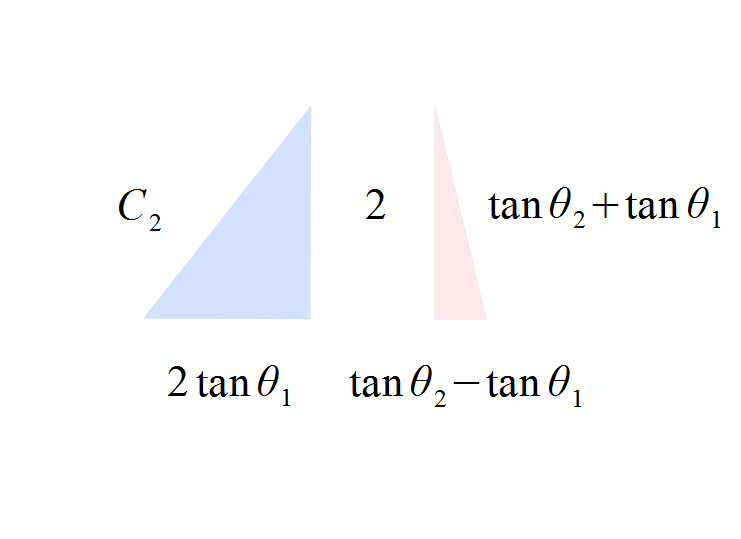
As you can see below we can unify the cosmic identity with trigonometry in the double triangle formation.
Trigonometric Functions
Unifying the cosmic identity with the trigonometric function (cos) using the double triangle formation.
Unifying the cosmic identity with the trigonometric function (tan) using the double triangle formation.